Monday, November 26, 2012

resurrection pass

Finally I made it to Anchorage for Thanksgiving! For years, Toby and Darcy have skied the 41 miles over Resurrection Pass on Thanksgiving weekend with good friends and a full holiday meal. This was my first time joining the tradition. Seven of us started out from Hope, three of us skied all the way across, two joined from Cooper Landing. The snow was sometimes thin, the downhills fast and scary. But the sun was out, the skiing was fast, and the food and company couldn't be beat.

Monday, November 12, 2012

snowgo

I'd been on a snowmachine exactly twice before I bought one this fall, on a whim, for $600. The first time was several years ago at Arctic Man, a Burning-Man-like gathering for slednecks in the middle of the Alaska Range. The event is centered around a race involving speed skiing and snowmachines, but basically people go to hang out, drink, and ride around on anything with an internal combustion engine. Tens of thousands of people camp out in a glacial valley without even a payphone in the summer. They ride snowmachines up a mountain to watch the race.
I went as a reporter with the News-Miner. The paper rented one snowmachine for me and John, the photographer, and since he had more experience, he drove. His response to any threat -- of bogging down in deep snow, mostly -- was to gun it. Knowing what I know now, his instinct or training was probably right, but at the time it seemed like a jerky ride. After tipping over repeatedly on overworn trails, I tried driving and promptly tipped us over, camera gear, notebooks and all. The thing I remember most was struggling to breathe with the air fouled by a thousand two-stroke engines. 
The second time was last winter, testing out my friend Mark's new-used Polaris. I took it up to 30 miles an hour, nervous as ruts in the snow tugged at the skis. Ian took it up to 60.
I still consider snowmachines kind of stupid, at least for recreation. Moving under your own power is more rewarding, and while it won't get you as far, certainly allows for a deeper appreciation of the landscape, without any of the smoke and noise. "I'm not usually like this!" I wanted to tell the one hiker we passed on the trail this weekend in the White Mountains. (Mark and Ian and I went about 25 miles on Saturday, out on a mixed-use trail from Wickersham Dome until the ruts and tussocks and slush made the riding less fun.)
So why do it? I guess to experience something that's such a big part of Alaska life, used for hunting, trapping, and travel. To open the door for new explorations, or at least gain the skills to make them possible. 
And, I'll admit, it's pretty darn fun.

Wednesday, August 1, 2012

tracks

Can you see them?

Sunday, July 29, 2012

granite tors

I hiked the Granite Tors trail again yesterday. When I hiked/ran it five years ago, it was a dramatic mix of drizzle and sun. Yesterday was so sunny and warm I didn't carry a rain jacket. The blueberries are just about ripe, the salmonberries mostly mush, which is to say perfect. There were lots of hikers, a mother and young bull moose, and lots of bear sign on the trail (they're eating blueberries, too). I couldn't help but run the last few miles on weathered grey boardwalks that gave with each step.

Monday, July 23, 2012

chitina

I went to Chitina this weekend with some friends. We knew the fishing might not be good -- the dipnetting hotline said as much -- but we figured we might catch it before it got bad, or have a relaxed weekend and hit it when it got better, or maybe just power through and put in all the hours it took.
Now, even with hindsight, I'm not sure if we were foolish or just unlucky. As many times as I've gone to Chitina for dipnetting, there are some things I never learn, the largest of which is that it's impossible to have a pleasant weekend at Chitina. You can camp, with a car, but there are none of the luxuries of car camping. You're hiking, on a trail of sorts, but it's dusty and windy and you're carrying an awkward load. After we got skunked on Saturday, it simply did not seem worth it to hang out Sunday and try again Monday, despite the hundreds of miles we'd driven. Such is Chitina. You come, you fish, you go home -- whether you got your fish or not. Last year a friend and I caught 65 fish in 4 hours. This year we fished 10 hours and got one.
There are two main variables, it seems. First is the fish -- are they coming up the river? Are there lots, and are they passing the right spot at the right time? Second is the water level -- when the water rises too much, the fish stop moving upriver (even at low water, it's a wonder they can beat the current). One can monitor these variables with sonar and river gauges.
Then there are the gray areas, the art in place of science, the stories we create to explain the unknown. As we sat on the rocky bank, nets in the water, I imagined the fish moving upriver. (The water is so thick with glacial silt it's impossible to see anything under the surface.) I imagined them hugging the shore, slipping into eddies as they find them, following some chemical trail to their natal streams. I reached my net toward the eddy line, where the main current met the swirl of the eddy. Is the current less, the eddy stronger, at the bottom? I remembered a Native fisherman in Galena describing the narrow "trails" fish follow up the Yukon. Kings take one trail, chums another. Moving your fishwheel a few feet to one side can make all the difference. When Mark caught our one fish, I imagined it a forerunner. Then a straggler. Or maybe an independent fish that battled the current when others rested.
Other people invent theories, too. That silvers run at night. That the fish will start moving again when the shade reaches the right bank (that's how it worked for someone last year).
The week had been warm and sunny, and the water had been rising from snow and ice melt; one gauge measured 14 feet on Tuesday, 15 on Thursday, 16 Friday, and 17 Saturday. The fish seemed to stop moving sometime Saturday morning. When we arrived around midnight on Friday, we'd pitched a tent and slept 6 hours. (Scrambling on loose rock next to a raging river in near-dark seemed foolhardy.) The man who parked next to us had gone straight to fishing and had his limit by the time we woke up.
On Saturday, we watched the water rise hour-by-hour, moving up the bank as our perches became inundated. We knew some fishing spots were better than others at high water, and we figured the fish in the river had to go somewhere. From the trail, we looked down on a giant, slow eddy. People were fishing from a pair of boats. Maybe this is where the salmon rest. We crashed through alders to the eddy. Now there was one boat, drifting slowly upriver in the eddy, motoring back down, drifting again. The boat was close enough that we could talk easily with people on board. They were pulling in multiple fish on each pass. 
I nearly ran back up to get my gear and down again to start fishing. We fished one hour, two hours. We moved spots. We tied our nets to rocks and logs. I waded in. And we caught nothing. Was the banana I ate for breakfast bad luck?

Wednesday, July 18, 2012

WEIO

The World Eskimo-Indian Olympics started today in Fairbanks. I went mostly to check out the crafts -- the incredibly soft sea-otter-fur hats, the homemade ulus -- but stayed to watch the preliminaries of the one-hand reach. A sealskin ball is hung from a line at a specific height, and the challenge is to touch it with one hand while balancing your whole body on the other hand. Some made it look easy. Others strained, fell flat on the floor, jumped up shaking their wrists. Contestants and spectators clapped not when someone succeeded at a given height, but when someone gave it their all for three tries and failed. The ousted contestants jumped up with smiles. Over and over, when someone reached and missed, or couldn't get high enough, another competitor would come offer tips -- where to place the bottom hand, how to arch the back. It was amazing to watch.
From my seat in the stands, I figured I could do this, at least at the low heights, where it seemed you could rest a hip bone on the arm bones. I've know for years that I could balance on my hands; getting to one hand seemed mostly a question of strength. I got the sense there hadn't been much training among the contestants. One bounced like a boxer to warm up, and a few others stretched, but most just waited their turn and competed.
Now, having tried at home, I am humbled. Whether it's a lack of strength or technique I don't know, but I cannot imagine balancing on one hand, let alone reaching 46 inches into the air with the other. Power to the tall guy in Adidas soccer shoes. Power to the girl in beaded moccasins.

Monday, July 16, 2012

triathlon

It's a luxury of summer in Alaska to on a Friday mull plans for weekend adventures. Mark and I considered a hike/float trip off the Denali Highway, a hike from the seldom-visited Elliot. In the end, we planned a multi-leg adventure: drive to Nenana, bike back to Fairbanks, canoe to Nenana, drive home. Each was adventure enough for a day, but we decided to do both in one day.
To complete the triathlon, on Saturday we hiked the 16-mile Stiles Creek Trail -- nice enough, but best left to the 4-wheelers. Sunday we headed to Nenana. 
The ride back was pleasant -- nice weather, little traffic, some good downhills -- and my knees handled the 60 miles with surprisingly little complaint given my complete lack of training.
We feasted at Lulu's, then changed clothes and got in the boat. It's the fourth time I've done the 50-mile float to Nenana. Once I did it in 9 hours; another time, we took three days. It can be an easy float, but it's big water, with whirlpools and fast current and hard eddy lines, and I approach it with cautious respect. Around 8 at night, after an afternoon of patchy rain, the wind started to howl, kicking up waves as it blew upstream. The mid-July breeze turned an otherwise relaxed float into a wilderness trip. We pulled over, added layers, made a hot dinner. We were maybe 10 miles from the highway, 20 miles from the nearest village. After an hour or two from Fairbanks, we'd seen no boats.
Recharged, we tried again, and later stretches of water proved less susceptible to the wind. We followed lee shores, took side channels when they appeared. Banks I remembered from three years before were radically reshaped by erosion. Birch with green leaves still on leaned at all angles from crumbing shores. Beaver had mowed down rows of thick cottonwoods.
I was surprised, I guess, by the number of active camps. We never saw people, but did see a handful of boats tied up, wall tents, even some teepees. On a rainy night, it's still a wild place. Near Nenana, it was nice to see a big smokehouse going up, and a new fish wheel in the river with its spruce poles still golden yellow.

brooks range

I'm not sure why the Brooks Range feels so different from the Talkeetnas. Maybe it's the distance from urban areas, or the high latitude and its real midnight sun, unpredictable weather, and effects on flora and fauna. It's a place of lore, of magazine photos and trips-of-a-lifetime. Gates of the Arctic park prides itself on a complete lack of amenities -- no roads, no trails -- and the whole range remains inaccessible to most through the high cost of getting there and the skills needed to travel there safely.
I've been to the Brooks Range half a dozen times to hunt caribou, hiking the obligatory five miles from the road in an act that seems adventurous enough to warrant leaving emergency info at home. But I would never have attempted the adventure I had there this summer without my friend Toby, whose wilderness skills and enthusiasm are rivaled only by his fitness. Toby taught me how to travel and camp up there, and helped me experience some of the most beautiful places I've ever been.
Our trip was actually a combination of trips. Toby was part of a crew -- mostly from Anchorage, but also Homer and Colorado and beyond -- that set up a base camp in the upper Alatna River drainage, near the Arrigetch Peaks. Led by legendary adventurer Roman Dial, they were there to packraft mountain streams draining into the Alatna, some of which I would not have gone anywhere near with a boat. I joined the crew for the second week, indulging in base-camp life (fresh food, river-chilled beer) and exploring a few of the creeks, boating the mildest among them. One cloudy day we hiked into the high peaks -- huge slabs of dark, sheer rock rising nearly straight up for hundreds or thousands of feet. The creek we followed tumbled down over rock ledges, making slides and waterfalls that tempted the more experienced rafters.
After that week, those who had to fly home did -- on a vintage Beaver with soft tundra tires for landing on gravel bars -- and five of us started hiking. Look at a map. Deduce. Ask those who've been. Roman recommended a route up the Pingaluk, rather than the Nahtuk, and so we did that. We walked 10 hours the first day, stopping near midnight, when the near-constant stream crossings had started to numb my feet. The next day we crossed a pass and headed down the other side, following Kevuk Creek now. (Even walking, the rivers are the best way to travel up there.) Toby and I stopped after 12 hours, at my request. The others, one of whom was trying to catch a plane, pushed on toward Anaktuvuk Pass, another 50 miles away. Two were Alaska Wilderness Classic champs.
Toby and I made it to Anaktuvuk Pass, about 100 miles from the Alatna along our route, in four and a half days. We visited the museum, picked up the food Toby had had delivered, and packed up again the next day. I'd worried about my fitness, the ability of my joints to handle 20 miles a day of bushwhacking and tundra walking, and it was a huge relief to arrive in Anaktuvuk, a Native village perched high in a mountain pass, with regular air service to Fairbanks. Somewhat refreshed that next day, it calmed me to think it was only 60 miles to the Dalton Highway. I knew I could do it, whatever the terrain. And that's when I realized my sense of what's possible had changed. We made it to the road in four days.

Friday, September 2, 2011

fall

Yesterday afternoon, before evening even arrived, the dew dropped like it hasn't all year. The tools I was working with clouded over, metal turned cold to the touch. Sandhill cranes arrived flock after flock on their way to places like Arizona, dropping out of the sky with long legs dangling. It was the first day that felt solidly of fall. Moose season opened yesterday, but Ian and I are gearing up for caribou instead. We'll leave this afternoon and drive north with oversized sleds and a canoe, look for caribou somewhere north of the Brooks Range, then hike the mandatory five miles from the road over tussocks, maybe lining a canoe up a creek. Sometimes there are specific things one learns hunting, but mostly it is senses of things, built up over time -- how close you can get to an animal before it spooks, whether it is smell or sight or something else they find most frightening. One also learns how to think about hunting. Last year we saw thousands of caribou and came home with nothing; other years have been more lucky. And while veteran hunters probably have the right to credit skill over luck, it would be foolish to think you are in control. The best you can do is prepare, put yourself in the right spot, and wait, and there's something wonderful in that.

Monday, July 25, 2011

talkeetnas


Near the end of our 15-day hike, James, explaining some lack of equipment or maybe physical preparation, remarked, "I thought this was going to be a river trip." I laughed, because it seemed like a gentle way of saying, "What did I sign up for?" We'd endured near-constant rain and clouds, soggy feet, slippery rocks, and miles of tough bushwhacking -- the kind of challenges that can wear on you, but also make you feel you've survived, make you appreciate the sun even more. In the end, I don't think any of us would have traded our trek for anything.
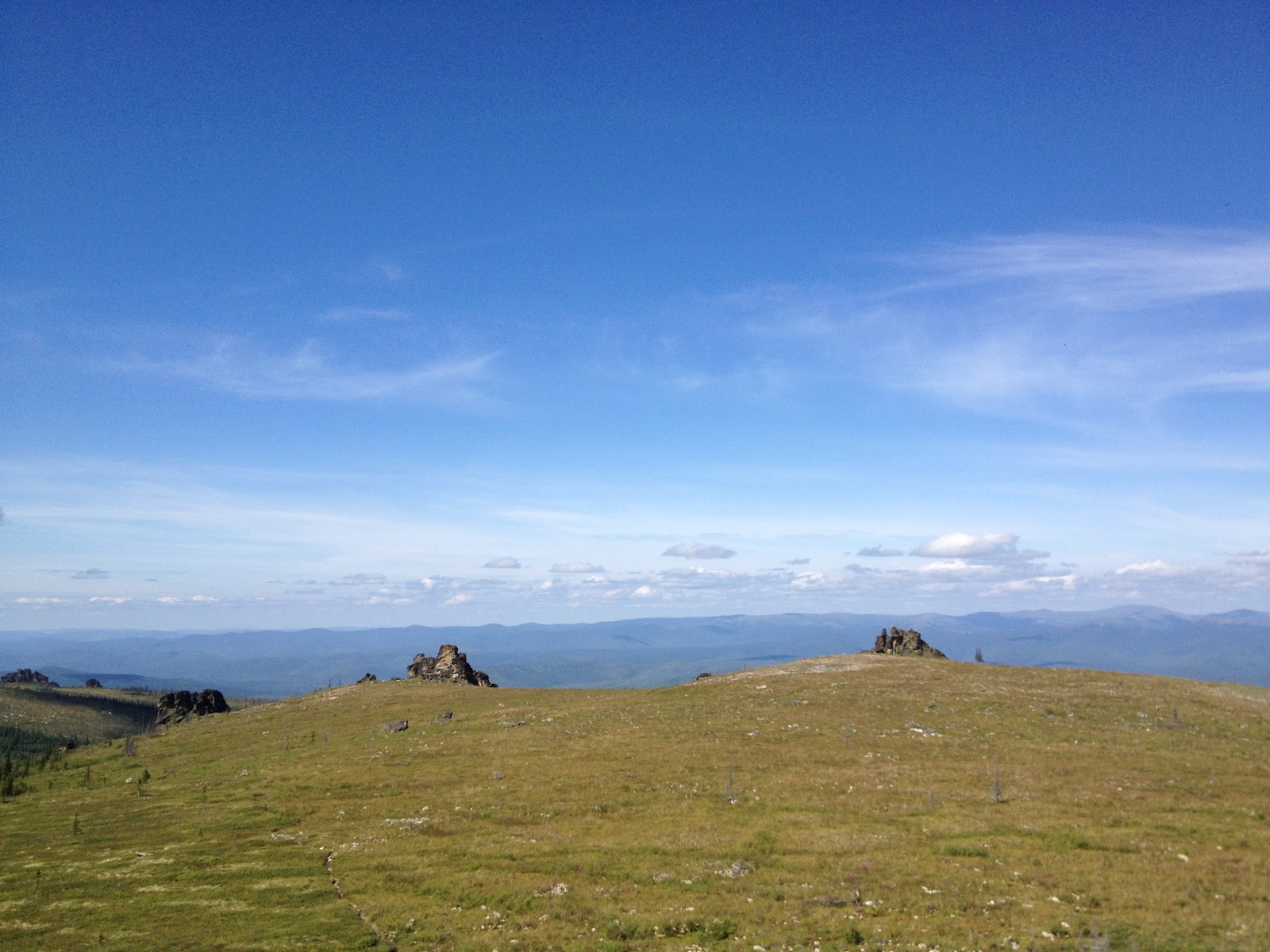
It had, in fact, started as a river trip -- maybe a float in ANWR, or a hike-float combo through Gates of the Arctic (there are so many choices in Alaska). In the end, Toby and Darcy proposed something closer to Anchorage, with fewer bugs and no costly fly-ins, but still awesome. We started on the Glenn Highway and hiked 140 miles through the Talkeetna Mountains to the rail line northeast of Talkeetna, off the Parks Highway. We followed Jeep roads for the first day and a half and found some old tracks again on the last day, but in between, we followed only caribou trails -- up this valley, over that pass and down again. We watched caribou float over the tundra and a grizzly bear devour a caribou calf. We picked our route based on the elevation lines of topo maps.
For three days, we made camp in a high valley near even-higher peaks where a bush pilot had formed a crude runway by placing white rocks in a straight line on a patch of tundra. A pilot flying a two-seater with tundra tires brought us food, fuel, beer and wine, which we bundled at night in a contractor bag swollen like Santa's sack. The sun came out and we climbed a 7,300-foot peak with spectacular views of mountains and glaciers. Awesome indeed. (Read Darcy's account and see more pictures here.)

From our pilot, we learned that NOLS makes a trip through the Talkeetnas each summer. Toby, from whom I have learned a great deal about wilderness travel, scoffed at the idea of paying for such skills, and I think it irked him to imagine that our trip was not unique. (After Day 2, we saw no one but our pilot.) So for the rest of the trip, we joked about those NOLS kids -- how they could always light a fire with one match, how they were expert bushwhackers who never complained about the weight of their packs.
Today there's
a story in the paper about a bear attacking the NOLS group, seriously injuring two. It sounds like they might have run, which is a no-no, but also did things right, like making lots of noise. It's hard to know what to think. It's only the second bear attack in NOLS history, according to the story, so maybe there's comfort in the odds. No matter how prepared you are, with bear spray or firearm, I imagine there's always some risk -- a trade, I guess, for the opportunity to experience places as wild as this.