The silence on climate change here in the capitol has been deafening, as the saying goes. I spend a good chunk of my time in the building, and aside from a few side mentions from the public during testimony on energy-related bills, there has literally been no mention of the issue. Gov. Sarah Palin mentioned climate change in her state of the state address, but only to note that her sub-cabinet group on climate change was studying the issue.
Anyway, the Immediate Action Work Group, a temporary group set up under the sub-cabinet, just issued its latest report. It has a few broad policy recommendations that suggest they're still trying to come up with a process that makes sense. But it also has several FY 10 funding requests, many of which are not currently in the budget bills working their way through the Legislature. If any of them are going to make it in, it's going to take some quick, effective lobbying. The session ends April 19. As for who will do that lobbying, beats me.
Tuesday, March 31, 2009


Sunday, February 22, 2009
dan moller

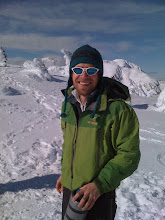
 This is why Juneau is amazing. Drive across the bridge from town to Douglas Island and up the hill about half a mile, then hike for a few hours and you end up here.
Friday, February 20, 2009
jumbo, and other news
 Sorry for the delay. I had a story about renewable energy run in the New York Times, with photos, video, and a blog post to boot! More on that later. And yesterday afternoon I climbed a small mountain on Douglas Island. The snow was deep, and came all the way down the water. The trees are huge, of course. And the bits of blue in the sky and white of the mountains down the channel were striking -- so blue at times that I mistook the sky through the trees for something man-made. I made it to the shoulder on Jumbo just as it was getting dark, then skied down the winter trail (snowmachine trail) with shaky legs as the trail disappeared and lights came out in Juneau below.
Sunday, February 1, 2009
soggy juneau
 Alas, I missed the powder day at the mountain this weekend. That was yesterday. I got out today, when the sky was so thick you could hardly see across the channel, and hiked up to the tram. It was only a few miles, but offered a taste of the mountains all the same: the chill of wet skin at the top, the warmth of good clothes and exertion, the perfect asymmetry of the hike up and down. The snow, knee-deep at the top, thinned and turned to slush on the way down.
Monday, January 26, 2009
wind-powered gas line?
There was a funny moment today in the Capitol when a VP from Canadian pipeline builder TransCanada updated lawmakers on his company's proposed $26 billion natural gas pipeline from the North Slope to Alberta. Trying to demonstrate the small footprint of the pipeline's compressor stations, which pump gas down the line, the VP, Tony Palmer, compared the facilities to wind turbines -- a whole station would cover an area smaller than the spread between two turbines, he said, and the tallest building would be only one sixth as tall as a wind turbine. It seemed like an odd comparison. Palmer actually said something like, "So if you're familiar with wind turbines, . . ." which I imagine most Alaska lawmakers are not.
Once on the subject, Palmer took the opportunity to mention that TransCanada is building Canada's largest wind farm -- totaling 740 megawatts, or several hundred utility-scale turbines. This also seemed like an odd thing to note. Did Palmer think oil-state legislators would be impressed by the green-power project? Lawmakers did include a softly worded requirement in recent pipeline legislation requiring companies to say how they would handle future carbon regulation, but environmental concern is rare here.
Palmer went on with his presentation, and a little later, one of the committee members, Bryce Edgmon, returned to the turbines. Is TransCanada planning to put turbines in Alaska? he asked.
This really was an odd question. Lawmakers have studied this project for many months, and it's hard to imagine that something like using wind turbines to power a giant natural gas pipeline would simply slip past unnoticed.
But Palmer's response suggested the idea wasn't completely off base. TransCanada is planning to use natural gas to power the compressor stations, he said, but the company has used electricity on other pipelines, and has built power plants (burning natural gas) at some compressor stations.
"Will those be things that we look at?" Palmer asked himself. "Clearly they will be."
So maybe Edgmon is onto something.
Sunday, January 25, 2009
dan moller


 It's been another weekend of beautiful weather and marginal snow. I skied Saturday above the Dan Moller cabin, atop a ridge on Douglas Island with views down Seymour Canal and Stephens Passage. Tonight we're all hoping for snow. And no, that's not my dog.
Tuesday, January 20, 2009
mt troy
 Well, the boots are out. I've been a little busy lately, but did get outside this weekend. On Saturday, I hiked up to the tram with my snowboard, although I didn't bother with the heavy, wet snow. On Sunday, I skinned up Mt. Troy with some folks and got in a few turns, despite crusty ice at the top and small ridges formed by runoff below that (shown here). With any luck, it's a temporary downturn in the skiing conditions. I can't complain about the sunny skies and T-shirt weather.
Tuesday, January 13, 2009
stuck in a cold place
 I made it to Juneau.
I mention this because for a while there, I thought I might not. I left Fairbanks on Friday, a little later than planned, and promptly got stuck a few hours down the road in Tok, the place that was so cold last week it made national news. I’d stopped to send an e-mail and noticed smoke from under the hood. It was just getting dark. A woman stopped behind me – as people will do when it’s cold in Alaska – and offered to follow me into town. Later, when I ran over a rabbit and stopped again, we checked the oil, found none, and added a quart. It was windy, and you had to be careful with your fingers. The oil turned to molasses in the minute it took to pour it.
This woman and later her husband, longtime Tok residents, showed a kindness that went beyond helping the needy traveler and took me somewhat by surprise.
I followed the woman to her house, where her husband added some more oil. When I noted the cold, the husband explained that it had actually warmed up – it was only 62 degrees below zero, and had been 69 below a few nights before. We could see now that oil was splattered on both sides of the engine.
I spent the next 20 hours at Fast Eddy’s restaurant, the accompanying motel, and the towing and service shop across the highway. I once tried walking the half-mile to the gas station for a candy bar, but turned around when my nose started to tingle. The temperature never got above 39 below.
At first I considered pushing ahead, as the problem itself wasn’t that bad (there was oil in the engine, it just wasn’t showing on the dipstick) and would presumably resolve itself if I could just get out of this frigid cold.
But it wasn’t a good time or place to be driving an unreliable car. Even with bunny boots and down, 60 below would give you a chill fast. And the Yukon isn’t exactly populated. I remembered that awful Jack London story about the man whose life depends on his ability to start a fire in the cold, and I decided to get the car fixed.
The shop, Willard’s, gracefully fit me in to what was clearly a booked schedule – cars, tractor trailers, even a U-Haul were failing in the cold. My problem proved to be a frozen pressure control valve, which meant the truck basically just had to thaw out. The mechanic, short on sleep and with hands that looked like he’d given up on washing them, worked the ice out of various tubes and valves.
At Fast Eddy’s, where I must have drank a quart of coffee, everyone was talking about the weather – about the dog musher with the totally white nose, or the thermometer bottoming out at 65 below, or the pipes that froze in the school and flooded the computer room. I eyed humongous plates of food and watched the cars drive by out the window. I had already missed one ferry to Juneau and worried I would miss another.
When I finally got my truck back at 4:45 Saturday afternoon, I got in and drove. I reached Canada a few hours later, crossed Chilkat Pass around midnight, and drove back into the U.S. a little after 1 a.m. The snow was deep, the trees huge. And it was warm.
Monday, December 29, 2008
how to tan a caribou skin


 I finally tanned my caribou skin this weekend after putting off the project since early November. I did one last year, and remember the whole process being frustrating and hard – the kind of work that makes you physically sore. And it all needs to happen at once.
My goal this time was to meet the standard spelled out in John and Geri McPherson's Primitive Wilderness Skills, Applied and Advanced: the finished robe should "drape over your arm like a blanket, not fold like paper."
In my limited understanding of the process, actual tanning – with tannin, alum, or other chemicals – changes the chemical composition of the skin. Another, simpler way is to just replace the water in the skin with oil (also a chemical change, I suppose) and work the fibers as the skin dries.
That’s what I tried, partly with some caribou brains, which look like strawberry yogurt and are only safe because spongiform encephalopathy hasn’t been found in Alaska, and partly with a mixture of Ivory soap and neatsfoot oil.
I thawed out the skin, fleshed it, scraped off the membrane, shampooed and rinsed it, rubbed the brains and soap into it, and worked it hard on the stretcher.
Forty-eight hours later, it’s done. The skin is more like a blanket than paper, but still a little stiff, a little greasy, and not quite like store-bought. Not that you can buy a caribou skin. Caribou have warble flies that live under their skin at various times of the year, and the bugs leave unsightly marks. The store here instead sells tanned reindeer, the domestic version of caribou.
I can't help but wonder now if a turn in the dryer with some tennis balls wouldn’t soften up the skin. But there’s a good chance that would lead to disaster for the dryer or the fragile, hollow hairs, so I think I'll stick with what I've got.
calculating your carbon hoofprint
In Planet Slayer’s carbon calculator, you start out as a pig. A pig with a charming face and long eyelashes, but a pig all the same. A dog in a white lab coat named Prof. Schpinkee is watching over you with arms crossed, ready to help you figure out how big a greenhouse hog you are, and the best you can hope for is to be an “environmentally sustainable ‘green’ pig.”
Planet Slayer’s may be the least forgiving, but it’s just one of many carbon calculators available online. Tallying your footprint is the logical first step toward reducing your impact or “offsetting” your emissions with purchased carbon credits, and conservation groups, oil companies, and government agencies are all offering their own versions.
But figuring out how much carbon you spew is not easy, and not all calculators are created equal. I tested six – by the Environmental Protection Agency, The Nature Conservancy, BP, Conservation International, ClimateCrisis.net (Al Gore’s thing), and Planet Slayer (a project of the Australian Broadcasting Corp.) – and offer my unscientific review here.
The first thing to recognize is that carbon calculators don’t all calculate the same thing. The one on ClimateCrisis.net seems to be limited to home energy use and transportation. It lists the national average for per-capita emissions as 7.5 tons, which is nowhere near our full greenhouse gas footprint. Likewise, the EPA’s calculator is limited to emissions from home energy use, driving, and waste disposal. Conservation International’s and BP’s are limited to home energy use and transportation, including driving and flying.
Only The Nature Conservancy and Planet Slayer attempt to capture total emissions, or all the emissions “your choices create each year,” as TNC puts it. In the U.S., that’s something like 24 tons (22 if you just look at CO2 or 26 if you include the carbon dioxide equivalent from methane). At least that’s what you get if you divide total U.S. emissions by the number of Americans, which probably wouldn’t include the carbon impact of, say, a TV made in Japan and sold in the U.S.
Carbon calculators are by necessity crude tools. They generally factor in things like how much you drive, how you heat your home, how many people you share your house with, and so on. Your carbon count can start from zero and build as you go or start with an average and shift up or down depending on your energy choices. For everything else – if it’s included at all – carbon calculators generally just plug in a figure based on your country or state’s average. That is, they don’t try to tally up the carbon associated with every iPod, health insurance plan, and public library.
All calculators make the point that you can reduce your footprint by changing how you live, and they try to educate as they count. If you recycle everything, EPA’s calculator takes about 400 pounds of CO2 off your tab. If you eat a lot of meat, TNC’s calculator tacks on a few extra tons. Understanding the impact of those choices is simply a matter of watching the numbers in the right hand column go up or down.
That said, some calculators are more explicit than others. BP’s, for instance, offers direct lessons from a man with green hair, as he sips coffee at home or installs a solar panel on a roof in hardhat and sweater vest. “Compared to a car, public transportation can be a more efficient way of using energy to move people around,” he says as he walks through an airport.
Where most calculators fail, IMHO, is in areas where carbon impacts are harder to quantify. Direct energy consumption is pretty easy, even if some big assumptions are involved – driving a car that gets so many miles per gallon so many miles a year will burn a certain amount of gas and produce a certain amount of CO2. Ditto with flying, home heating, and electricity.
But the carbon behind everything else is harder to figure. Most calculators don’t even try, and rely instead on those big averages. The one that doesn’t is Planet Slayer, which makes the point that there’s carbon behind almost everything we buy and do. One question in its calculator asks, “How much money did you spend all up last year?” Answer less than $10,000 and you, the pig in the trailer, shrink to smaller than the average Aussie pig. Choose $40,000 and you get some extra rolls of belly fat. Pick $70,000 and you turn into a slobbering, snotty swine who can’t keep his gut off the floor.
Planet Slayer explains in the fine print that it’s assuming there’s 1.6 kilograms of CO2, on average, behind every Australian dollar you spend. And that your driving, household energy use, and eating habits account for less than 20 percent of your overall emissions. “The thing that makes a real difference to your bacon-ness is how you SPEND the rest of your money,” it explains.
This expands the common dialogue over carbon footprints from simple things like what we drive and what kind of light bulbs we have to what we eat and what we do for fun. It also leads to some unexpected assertions, like the one that taking a cab is less polluting than riding a bike. “Not really, but because we pay so much to ride in taxis ($1/km), it leaves us less money to spend on stuff that’s even worse for the environment.”
Even if the U.S. economy is more efficient than Australia’s (just guessing here), the idea of a pint of oil behind every dollar is important. When you imagine downing a cup of oil with every cup of OJ, that juice starts to seem less appealing.
Planet Slayer lets you clean up your act by spending on “stuff that’s better for the environment,” like energy-efficient and second-hand items, rather than “ordinary stuff,” like eating, drinking, and going out. The implied lesson isn’t spend less so much as spend wisely.
Partly I blame us media for ignoring this concept. But it also seems like a bit of a third rail for green groups and politicians, even those serious about reducing emissions. Suggesting that people need to buy less stuff is not really going to fly. The effort, justifiably I suppose, has been to reduce the carbon in our economy rather than shrink the economy itself.
In any case, focusing on home energy use, transportation, food, and waste is probably a good start, and complex enough. I tried out the six calculators on my own life and got a wide range of answers. Each calculator asked for different inputs, and none really fit my Alaska lifestyle (living in a dry cabin, eating my own food); Gore’s calculator, which allows you to input the year and make of your car, also mysteriously omitted Toyota’s 1997 line of vehicles. That said, I tried to be consistent with my inputs.
Here’s what I got.
EPA: 12.9 tons (home energy and driving)
Climatecrisis.net: 15.3 tons (home energy and transportation)
Conservation International: 18.3 tons (home energy and transportation)
BP: 12.5 tons (home energy and transportation)
Planet Slayer: 31.9 tons (everything)
The Nature Conservancy: 43 tons (everything)
TNC’s 43 tons is a pretty strong indictment. And according to Planet Slayer, I used up my sustainable share of the planet’s resources in 7.9 years. I think I was unfairly billed for heating and electric costs, and I don’t spend that much money on “ordinary stuff,” but I'm definitely no green pig.
Subscribe to:
Posts (Atom)