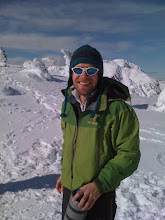
Sen. Ted Stevens gave his annual address to the state legislature today, and he spent a good chunk of time talking about UAF's Katey Walter and her research on the release of methane from Alaska lakes and ponds. He called her "one of Alaska's brightest young scientists" and gave a synopsis of her research and his idea.
Methane is bubbling up out of lakes -- potentially faster now as permafrost thaws with warming temps -- and into the atmosphere, where it has a strong greenhouse gas effect, he said. If the state and the feds can assess the supply and figure out how to use it, they could address climate change and high rural energy costs at the same time.
After his address, Stevens took questions from the press in the House Speaker's office. He sat on the table like he always does, and he had Walter sit next to him.
Walter said there's a tremendous amount of methane already coming out of lakes, and gas hydrates and natural gas on top of that. She explained that farmers in the Netherlands were already using methane in groundwater by bringing it to the surface and separating out the water with a low-tech, sprinkler-type system. The sprinklers are topped with heavy caps that "naturally" pressurize the gas enough to pipe it into homes, where it can be used for heating and cooking.
"They don't pay heating bills," she said.
Stevens said he's already asked high-ups in the Bush administration about having NASA do spectral analysis of methane hotspots by satellite, or aerial surveys at least. The state could chip in to test the feasibility of the gas as an energy source, he added.
When someone asked why the state hadn't looked into this before, Stevens said no one even knew about leaking methane before Walter's research. "She discovered it."
(I wrote a bit about her research in November.)
He said Walter is working on a pilot project to heat homes in one place and possibly generate power in another.
She said the technological trick will be figuring out a way to harness the gas bubbling up from lakes rather than the gas contained in subsurface pools.
The whole thing amounted to an impressive endorsement of Walter's research -- Stevens had little flyers Walter wrote distributed to every legislator -- that pretty much came out of the blue.
It left me and the other reporters a little befuzzled. How big a deal is this? How new is it? And how does lake methane relate to coal-bed methane? (Or natural gas, I might add, which is mostly methane.)
Stevens presented Walter's idea as something of a panecea -- a solution to the rural energy crisis that's doubly good for climate change. Capturing and burning the gas would replace another (potentially carbon-heavy fuel source), and it would release carbon dioxide to the air rather than methane, which has the stronger greenhouse gas effect.
Walter made that last point about how burning the gas was actually better (in terms of climate change) than letting it escape, but I'm skeptical without knowing how much CO2 you'd get from a given amount of methane.
In any case, Go Katey!
Tuesday, February 19, 2008


Sunday, February 17, 2008
who needs pictures, anyway?
OK, so I sent my camera through the warm/gentle cycle. With a small miracle, the thing might work once its tiny electronics dry out, but here's an attempt to describe my weekend backcountry outing with words alone.
Imagine hiking up a mountain from 200 feet above the channel to 2,500 or 3,000 feet, to the shoulder of the highest mountain on the island across from Juneau. It's cloudy and windy just above treeline, but below you it's almost clear and across the water you can see the city below and the wall of mountains behind it. The sky is gray and white with clouds that look like smoke.
The snow on Mount Jumbo is crusty. There's snowmachine tracks most of the way up, icy and hard and fast for walking. In the woods, the crust is hard enough to keep the skiers on top and to keep me, on snowshoes, mostly on top. Once we bust out of the trees into the big open bowl below the summit, the snow changes again -- windblown and hard in places, soft and deep in others, so that each step for me involves sinking in, pushing off, sinking in again.
I went with friends who know a lot more than I about avalanche danger. We dug a deep pit in the snow a little ways down from the summit, checked the hard and soft layers, studied the snow crystals, measured the temperature change in the snowpack. I jumped on a carved-out block of snow harder and harder until I and my snowboard set off a foot-thick layer. The way I understand it, you're never completely safe in the mountains, but there's ways to reduce your danger by choosing the right path, staying off bad snow, and having the gear you need for a rescue as a last resort.
All went well Saturday -- in fact, glorious. We were out for about six hours and had probably 2 or 3 minutes total of real nice backcountry skiing (that's called earning your turns), plus a mostly scary slide down the narrow snowmachine trail to town. Wish I had some pictures to share . . .
Imagine hiking up a mountain from 200 feet above the channel to 2,500 or 3,000 feet, to the shoulder of the highest mountain on the island across from Juneau. It's cloudy and windy just above treeline, but below you it's almost clear and across the water you can see the city below and the wall of mountains behind it. The sky is gray and white with clouds that look like smoke.
The snow on Mount Jumbo is crusty. There's snowmachine tracks most of the way up, icy and hard and fast for walking. In the woods, the crust is hard enough to keep the skiers on top and to keep me, on snowshoes, mostly on top. Once we bust out of the trees into the big open bowl below the summit, the snow changes again -- windblown and hard in places, soft and deep in others, so that each step for me involves sinking in, pushing off, sinking in again.
I went with friends who know a lot more than I about avalanche danger. We dug a deep pit in the snow a little ways down from the summit, checked the hard and soft layers, studied the snow crystals, measured the temperature change in the snowpack. I jumped on a carved-out block of snow harder and harder until I and my snowboard set off a foot-thick layer. The way I understand it, you're never completely safe in the mountains, but there's ways to reduce your danger by choosing the right path, staying off bad snow, and having the gear you need for a rescue as a last resort.
All went well Saturday -- in fact, glorious. We were out for about six hours and had probably 2 or 3 minutes total of real nice backcountry skiing (that's called earning your turns), plus a mostly scary slide down the narrow snowmachine trail to town. Wish I had some pictures to share . . .
Wednesday, February 13, 2008
state steps up
To follow up again . . . I just talked with Mike Black from the department of commerce, who's one of the co-chairs of the immediate needs work group of Gov. Palin's sub-cabinet on climate change.
One of Palin's two climate-related budget requests is for $1.1 million in grant money to be distributed by the department. Black said the idea came from his work group and from Sen. Ted Stevens' comments at a round table last November. Stevens "basically challenged the state to be involved" if it wanted to get federal funds, Black said. Big picture, the grant request shows the administration believes it's time to get involved, and time to take a statewide approach, he said. "The state hasn't really been involved up till now other than just discussing it."
The $1.1 million would break down like this. Grants of $100,000 to $150,000 would go to communities identified as having critical needs to help them plan to mitigate impacts. Actually dealing with the impacts would take additional state or federal funds. Black said the communities that would qualify were already identified, and included Shishmaref, Kivalina, Unalakleet, Shaktoolik, Newtok, and Koyukuk. Smaller grants of $30,000 to $35,000 would go to other communities based on need (anyone could apply) to help those communities gather evidence of being impacted by climate change, whether by thawing permafrost, coastal erosion, or something else. That information could them be used to leverage state and federal funds.
The other request, for $230,000, would mostly be used to develop a statewide stakeholder approach to identify mitigation and adaptation measures. The question remains whether lawmakers will approve the two requests.
One of Palin's two climate-related budget requests is for $1.1 million in grant money to be distributed by the department. Black said the idea came from his work group and from Sen. Ted Stevens' comments at a round table last November. Stevens "basically challenged the state to be involved" if it wanted to get federal funds, Black said. Big picture, the grant request shows the administration believes it's time to get involved, and time to take a statewide approach, he said. "The state hasn't really been involved up till now other than just discussing it."
The $1.1 million would break down like this. Grants of $100,000 to $150,000 would go to communities identified as having critical needs to help them plan to mitigate impacts. Actually dealing with the impacts would take additional state or federal funds. Black said the communities that would qualify were already identified, and included Shishmaref, Kivalina, Unalakleet, Shaktoolik, Newtok, and Koyukuk. Smaller grants of $30,000 to $35,000 would go to other communities based on need (anyone could apply) to help those communities gather evidence of being impacted by climate change, whether by thawing permafrost, coastal erosion, or something else. That information could them be used to leverage state and federal funds.
The other request, for $230,000, would mostly be used to develop a statewide stakeholder approach to identify mitigation and adaptation measures. The question remains whether lawmakers will approve the two requests.
Tuesday, February 12, 2008
putting the dollars in
First of all, I guess it's fair to say I won't be posting as often while I'm down here in Juneau covering the legislative session. And down here in Juneau while the state's biggest environmental conference is happening in Anchorage...
That said, there's fairly big news from the Gov's office these days. I've heard some grumblings from enviro folks that Palin's approach to dealing with climate change has been lots of talk and not so much action. Now that's a little harder to say. In a supplemental budget request for the current fiscal year, she's asking for $230,000 for her sub-cabinet on climate change and $1.1 million for planning grants for communities with immediate needs. It won't move villages, but it's a start.
Here's the story I wrote for today's News-Miner.
As a follow up, the state is formally proposing to go with the non-profit Center for Climate Strategies to develop a response plan. The state would chip in $180,000 (from the $230,000), and CCS would be responsible for raising the rest of the needed money (close to $1 million) from private charities.
CCS made its pitch to Palin's sub-cabinet last November. The group has done climate-related work in more than two dozen states, and has helped a number of them develop plans to reduce emissions in the most cost-effective manner (they argue many of the changes actually save money). Alaska would be somewhat different because it's already experiencing dramatic impacts from climate change. CCS is proposing one stakeholder process to work on mitigation measures -- emissions reductions -- and another to deal with adaptation. Here's what I wrote back then.
That said, there's fairly big news from the Gov's office these days. I've heard some grumblings from enviro folks that Palin's approach to dealing with climate change has been lots of talk and not so much action. Now that's a little harder to say. In a supplemental budget request for the current fiscal year, she's asking for $230,000 for her sub-cabinet on climate change and $1.1 million for planning grants for communities with immediate needs. It won't move villages, but it's a start.
Here's the story I wrote for today's News-Miner.
As a follow up, the state is formally proposing to go with the non-profit Center for Climate Strategies to develop a response plan. The state would chip in $180,000 (from the $230,000), and CCS would be responsible for raising the rest of the needed money (close to $1 million) from private charities.
CCS made its pitch to Palin's sub-cabinet last November. The group has done climate-related work in more than two dozen states, and has helped a number of them develop plans to reduce emissions in the most cost-effective manner (they argue many of the changes actually save money). Alaska would be somewhat different because it's already experiencing dramatic impacts from climate change. CCS is proposing one stakeholder process to work on mitigation measures -- emissions reductions -- and another to deal with adaptation. Here's what I wrote back then.
Thursday, January 17, 2008
lawmakers and wolves
 Boy, that was an terrible delay. Sorry. My only excuse is that I've been preparing for the trip down to Juneau and then making that trip, which actually turned out to be pretty amazing.
I had a lot of time to think -- it's about 600 miles from Fairbanks to Haines -- so I thought about how damn big the state is, about how it can be 60 or even 70 degrees warmer in one part of the state compared to another (Juneau v. Prudhoe, for instance), and about the wonder of the Alaska Legislature -- that a bunch of businessmen, pilots, lawyers and construction workers gather in tiny Juneau every year to make some really important decisions.
And I saw two wolves!
Both were in the Yukon, and both looked me in the eye for a few seconds before running off. The second I saw actually stuck around a while, trotting past my parked truck and going to munch on some roadkill. He looked awkward at first in the deep snow, then started to just glide over it when he decided to run.
There's actually a lot going on in climate news, which I'll try to get to soon. The gov's sub-cabinet's work group dealing with imminent issues met earlier this month and is meeting again tomorrow. I got to talk with Don Young and Ted Stevens about climate change (Stevens' views still remind me of SNL's Pat). And the polar bear listing is big news even with the decision delayed.
Wednesday, December 26, 2007
ak in the news: walrus, and now seals
Happy holidays folks, and sorry for dropping the ball here for a bit. There's actually been some interesting news about sea ice and mammals, thanks to AP's Dan Joling and the first tricklings, it seems like, of study on how this year's dramatic loss of ice has affected bears, walrus, and ribbon seals. Joling had this update on walrus, and this one on seals.
There was also a back-and-forth between Gov. Palin and a woman from the Center for Biological Diversity on what to do about polar bears, in contrasting opinion pieces.
I wrote a story last week on making solar power in our solar-deprived Far North. (It's getting lighter now, if only slowly.)
There was also a back-and-forth between Gov. Palin and a woman from the Center for Biological Diversity on what to do about polar bears, in contrasting opinion pieces.
I wrote a story last week on making solar power in our solar-deprived Far North. (It's getting lighter now, if only slowly.)
Thursday, December 20, 2007
real cold
It's 32 below at my cabin tonight, the first real cold we've had this winter. For those who haven't had the pleasure of real cold, here's a few observations. The car light doesn't come on for a few seconds after I open the door, and the door itself doesn't close well -- something to do with the latch being a moving part. Extension cords get stiff. The moisture in cabin air instantly tops the saturation point of the outside air, and my glasses, chilled from a minute outside, freeze over with ice when I come inside. Every breath somehow feels like a nice deep breath. And you appreciate every time your car starts, and doesn't break down on the way home.
Thursday, December 13, 2007
ak in the news: duck hunting and sun dresses
 OK, I'm back. I had a few days off from work and flew 4,000 miles back to Massachusetts to see my mother and sister. There was a snow day when I was there, but from ice rather than snow. I thought back nostalgically when we had snow days from snow, and it seems those aren't gone completely. The East is getting dumped on now, and western Mass already has a foot.
I missed the Northern Alaska Environmental Center's protest "plunge" down a ski hill (pictured here), which didn't have great turnout but did make an AP story that ran around the world.
The NY Times had a good multi-media piece on observed changes in Missouri duck hunting, which had lots of voices from wildlife managers and hunters themselves.
National Geographic had some pretty amazing pics of permafrost.
And the AP wrote a story on sea ice, quoting the oft quoted and quotable Mark Serreze, and with the alarming premise that summer sea ice could be nearly gone by 2012.
Tuesday, December 4, 2007
ny times goes to barrow
The New York Times has a pretty exciting story about oil drilling bumping up against the whaling lifestyle in Barrow. There's even an audio slide show with some nice pics.
Sunday, December 2, 2007
climate change 101
 Please excuse my delinquent posting. I'm taking a class at the University of Alaska Fairbanks on climate and climate change, and last week was the final exam. I think I might have tanked it despite studying a fair amount. I completely missed the first question by confusing dynamical feedbacks, which deal with the transport of energy over latitudes, and biogeochemical feedbacks, which highlight the way biology can effect climatic changes.
Tuesday I have to give a half-hour presentation, which I've chosen to do on the Pacific Decadal Oscillation. The PDO is a pattern of atmospheric changes something like El Nino/La Nina but on a longer time scale and located primarily in the North Pacific rather than the tropical Pacific. It's important for Alaska because it caused at least some of a big jump in air temperatures in 1976, and confuses the question of how much the state has warmed in the last 50 or 100 years because of anthropogenic climate change. Some ignore the PDO as say, Look! Alaska is 4 degrees warmer now, while others point to the PDO and say, No sweat, it'll get cold again.
Today I had a scattered day of reporting that included interviewing an Alaskan environmental leader on Gov. Palin's environmental positions, blogging about the natural gas pipeline, covering a Ron Paul rally, doing a short profile of a woman from southern California, typing up the police report, and interviewing the brother of someone who was just killed by a drunk driver in Anchorage.
In my spare time, I've been cleaning my caribou skull to make a European mount.
Subscribe to:
Posts (Atom)