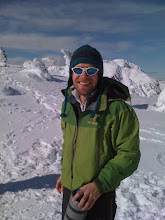
Sorry, I dropped the ball a bit for an exciting weekend away involving a truck, a 400-mile dirt highway, and big herds of caribou.
Here's some news clippings.
The News-Miner's RA Dillon wrote an update of climate legislation in DC.
The Arctic Sounder had a story on coastal erosion (and some amazing pictures of the whales caught this fall).
And Rachel D'Oro's story on walruses (walri?) showed up in the Sydney Morning Herald.
The big news today is from Gov. Palin, who's still urging the feds not to list polar bears as threatened under the Endangered Species Act despite recent USGS estimates that shrinking sea ice could do in two thirds of the world's polar bears in 50 years.
In a letter sent Monday to Interior Secretary Kempthorne, Palin wrote there wasn't enough evidence showing that the polar bear would be endangered "throughout all or significant portions of its range within the the foreseeable future," or showing that the bear populations weren't being well-managed already.
She didn't mention impacts on resource development, but argued the "listing of a currently healthy species based entirely on highly speculative and uncertain climate and ice modeling and equally uncertain and speculative modeling of possible impacts on a species would be unprecedented." The floodgates would be open to thousands of listing petitions, she wrote.
Palin said the state shared the feds' concern over the bears, and she asked for an extended comment period to sort things out.
This is a complicated topic. I wrote about it back in early April and again in mid April. Dan Joling did a story in late April.
Here's one summary.
Wednesday, October 24, 2007


Monday, October 22, 2007
whence the money?
The ADN's Beth Bragg had a good story today on the costs and issues association with coastal erosion and village relocation.
Rachel D'Oro did a profile yesterday of Stanley Tom, the administrator of Newtok and one of the people dealing with erosion.
Where will all the money come from?"That's the million-dollar question," said Sally Russell Cox, a state planner who is involved in the Newtok relocation.
Click here for the whole story.It's closer to a billion-dollar question, and it's getting a lot of attention at the federal, state and local levels.
The usual sources are being tapped, among them the U.S. Army Corps of Engineers, the state Department of Transportation, the Village Safe Water Program and the Bureau of Indian Affairs. Even the idea of using some of the Permanent Fund has been floated.
Cox hopes dollars alone don't drive the discussions.
"I hate to put things in economic terms, because these are human beings we're talking about," she said. "These are lifestyles they've led for thousands of years that have been passed on to them by their forefathers. How can you minimize all that (by putting it) in economic terms?"
In years past, Natives would have moved to safer places if nature's wrath threatened their homes. Today, things like school buildings, airstrips, roads and washeterias keep once-nomadic people anchored in place.
Rachel D'Oro did a profile yesterday of Stanley Tom, the administrator of Newtok and one of the people dealing with erosion.
Monday, October 15, 2007
stevens and landrieu
Here are audio files from last Thursday's hearing in Anchorage of the Senate's Subcommittee on Disaster Recovery. Sen. Ted Stevens was there, along with the subcommittee's chair, Sen. Mary Landrieu. It's the meeting where Stevens acted like a coastal storm, according to the ADN.
The first is panel one. The second is panel two plus a news conference.
Enjoy.
Http://Stevens.senate.gov/misc/erosion1.mp3
Http://Stevens.senate.gov/misc/erosion2.mp3
The first is panel one. The second is panel two plus a news conference.
Enjoy.
Http://Stevens.senate.gov/misc/erosion1.mp3
Http://Stevens.senate.gov/misc/erosion2.mp3
Saturday, October 13, 2007
Mr. Milkowski, get your Facts STRAIGHT!
The Anchorage Daily News picked up the story I did about the state climate change hearing and put it on their Web site. They have a deal where readers can weigh in, and the title here comes from someone who did.
Here's what happened. The engineer I wrote about, Dennis Nottingham, made strong accusations about what he said were failed erosion control projects in a few Alaska villages. Good reporting dictates that we check the facts -- even if someone else's name is on them -- and give anyone accused of something a chance to respond. I did neither of these because Nottingham's comments seemed most like opinions, which we don't check. In retrospect, I probably should have. A few people from Unalakleet challenged Nottingham's assertion.
The mini-blog gets into a critical discussion, but its tone is bad.
Here's what happened. The engineer I wrote about, Dennis Nottingham, made strong accusations about what he said were failed erosion control projects in a few Alaska villages. Good reporting dictates that we check the facts -- even if someone else's name is on them -- and give anyone accused of something a chance to respond. I did neither of these because Nottingham's comments seemed most like opinions, which we don't check. In retrospect, I probably should have. A few people from Unalakleet challenged Nottingham's assertion.
The mini-blog gets into a critical discussion, but its tone is bad.
gore v. akasofu
 Right, so Al Gore won a Nobel Peace Prize yesterday for his climate crusading. I spent part of the morning with Syun-Ichi Akasofu, who until this year led the fancy new International Arctic Research Center on the University of Alaska Fairbanks campus. His field of study is the northern lights, but lately he's been looking into climate change, and has been widely spreading his belief that it really isn't caused by human activities -- mostly -- and that there's nothing we can or should do about it other than adapt.
Thursday he talked to a group of UAF students; Friday morning he met with a group of local miners.
He ripped on the IPCC and its findings, and took a few jabs at Gore, basically for promoting bad science.
He's a very small man, and very polite, and also very witty, so when he sent me an e-mail later in the day, I'm pretty sure he meant it tongue-in-cheek. He had no problem with Gore winning the peace prize, he wrote, as long as it's not a science prize. More on him later.
the biggest of the small
 Fairbanks doesn't really have mountains like some parts of the state (think Juneau), but it does have hills, and today I rode the biggest of them, Murphy Dome. It was overcast, about 32 degrees, and fairly breezy, which is to say it could be one of the last nice, warm fall days here. Our summer was beautiful (I wrote a story about it), but it left in a hurry. As a fellow reporter said, it left without giving us a chance to say goodbye. Daylight is disappearing, too, at the rate of nearly an hour a week. I had an early meeting Friday, and when I got out at 9, the sun was just coming up and it was 11 degrees. So today seemed nice.
The ride was about 2300 vertical feet on a rocky dirt road covered with increasing amounts of snow. The top is right at treeline, and today the wind was howling and it was quite a bit colder. Coming down into a headwind, fast enough for it to be exciting, with cold fingers and toes, let me taste a little bear meat, which is good to do once in a while.
"Riding in the cold builds toughness," my friend used to say.
The round trip was about 27 miles.
Anyone else dealing with frozen waterbottles yet?
Friday, October 12, 2007
the ferocity of a US senator
The Anchorage Daily News' Beth Bragg had this colorful lede for a story on Sen. Ted Stevens' hearing Thursday in Anchorage on coastal erosion.
Sen. Ted Stevens displayed the ferocity of an Alaska sea storm Thursday morning, pounding federal officials for not responding aggressively enough to coastal villages imperiled by erosion, flooding and other effects of global warming.Here's the full story.
Thursday, October 11, 2007
follow the money
The AK Climate Impact Assessment Commission met all day yesterday in Anchorage. A discussion of sorts came together in testimony from three separate invited speakers, including one of the commission members, who charged the Army Corps with funding ill-planned erosion control programs. The Army Corps sort of defended itself, but also explained that it simply didn't have the authority, which sounded like news to Sen. Gene Therriault, a studious state lawmaker.
The commission also heard some dramatic stuff about the impacts (real and potential) on salmon, as well as eloquent public testimony on how climate change was making impossible a way of life that's been developed over thousands of years in tune with the land and climate.
I wrote about the allegedly wasted money. Here's the story.
Sen. Ted Stevens stopped in and made the point that erosion is a larger problem now that villagers have fixed infrastructure like power plants and schools. Later in the day, he traveled to Shishmaref with Sen. Mary Landrieu. He's holding a hearing on coastal erosion today in Anchorage. Check back later for an update.
The commission also heard some dramatic stuff about the impacts (real and potential) on salmon, as well as eloquent public testimony on how climate change was making impossible a way of life that's been developed over thousands of years in tune with the land and climate.
I wrote about the allegedly wasted money. Here's the story.
Sen. Ted Stevens stopped in and made the point that erosion is a larger problem now that villagers have fixed infrastructure like power plants and schools. Later in the day, he traveled to Shishmaref with Sen. Mary Landrieu. He's holding a hearing on coastal erosion today in Anchorage. Check back later for an update.
Tuesday, October 9, 2007
climate impact commission meeting today
The group set up last year by state lawmakers to tally the impacts of climate change in Alaska is holding its last public hearing today (Wednesday) in Anchorage.
The hearing is scheduled to last all day, with invited testimony running till 3:15 and public testimony coming after that. It's taking place at the legislative information office in Anchorage, but people elsewhere can listen in through their LIO or by calling (888) 295-4546.
Among those scheduled to speak is Fairbanks' own Luke Hopkins, who's on the Fairbanks borough Assembly and has been driving the push for a local response to climate change.
The full agenda is pasted below.
The Alaska Climate Impact Assessment Commission was supposed to do a final report with recommendations by January 10, but asked for and got an extension till February 29 -- making up for days lost last year to special sessions on oil and gas bills.
The hearing is scheduled to last all day, with invited testimony running till 3:15 and public testimony coming after that. It's taking place at the legislative information office in Anchorage, but people elsewhere can listen in through their LIO or by calling (888) 295-4546.
Among those scheduled to speak is Fairbanks' own Luke Hopkins, who's on the Fairbanks borough Assembly and has been driving the push for a local response to climate change.
The full agenda is pasted below.
The Alaska Climate Impact Assessment Commission was supposed to do a final report with recommendations by January 10, but asked for and got an extension till February 29 -- making up for days lost last year to special sessions on oil and gas bills.
Wednesday, October 10, 2007
8:55am Dial teleconference bridge - (888) 295-4546
9:00am Chairman Samuels welcome / introductions / check teleconference
9:05am - 9:30am Dennis Nottingham, PND Engineers - Erosion Control
9:30am - 10:00am George Canelos, Federal Co-Chairman,
Commission - Threatened Villages Relocation Issues
10:00am - 10:30am Lawson Brigham, Arctic Research Commission -
Marine Shipping Assessment for
(former 30-yr. Coast Guard officer, ice-breaker pilot)
10:30am - 11:15am A.O.G.A. presentation
11:15am - 11:45am Joseph David, Sr., Community Elder,
11:45am - 1:00pm (lunch break)
1:00pm - 1:30pm Sue Mauger, Stream Ecologist, Cook Inletkeepers -
1:30pm - 2:30pm COL. Kevin Wilson, Commander, Alaska District, Army Corps. of Engineers;
Patricia Opheen, PE, Chief of Engineering Division, AK District, COE Jon Zufelt, Ph.D, PE, Army Cold Regions Research/Engineering Lab
2:30pm - 3:15pm Alaska Municipal League - Climate Warming Impacts on Alaskan Communities - Mayors Bruce Botelho, Juneau & Mark Begich, Anchorage, and Luke Hopkins, Presiding Officer, Fairbanks-North Star Borough Assembly Member
3:15pm - 3:30pm (afternoon break)
3:30pm - 5:00pm (open public testimony)
new posts, new blog
 Welcome to northern flux, which takes over where the accidental naturalist left off.
I've made some big changes. I'm expanding the focus and hope to share some of the other things I care about while still being a resource for people wanting to learn about climate-related changes in Alaska, what's causing them, and what people are doing about them.
I'm a newspaper reporter, not an advocate. I just have a strong appreciation for the out-of-doors and a special interest in climate change.
All the old posts are still up. There are more links now, including some fun ones that have nothing at all to do with climate change. Feel free to join the discussion, and let me know if there's anything you'd like to see on the blog. I know there's people interested in this stuff, and I'd love to be a resource. You can reach me at stefan@billburg.com.
Subscribe to:
Posts (Atom)